
The redundancy, counted
Signing up for anything new has a particular kind of tedium to it: name, email, address, date of birth, phone — again. You've typed these exact details into a hundred other boxes. It feels redundant because it is. So we counted exactly how redundant.
We modelled the 30 everyday services a typical US adult signs up for — a bank, a couple of card accounts, an airline, a pharmacy, a streaming service, a utility, a rental application, and so on — and tallied every field each one asks for at signup.
By the numbers
The same you, typed 338 times
Opening 30 everyday accounts takes hundreds of boxes — describing a handful of facts you already own.
to open those 30 accounts.
about you describe almost all of them.
is data you already handed another company.
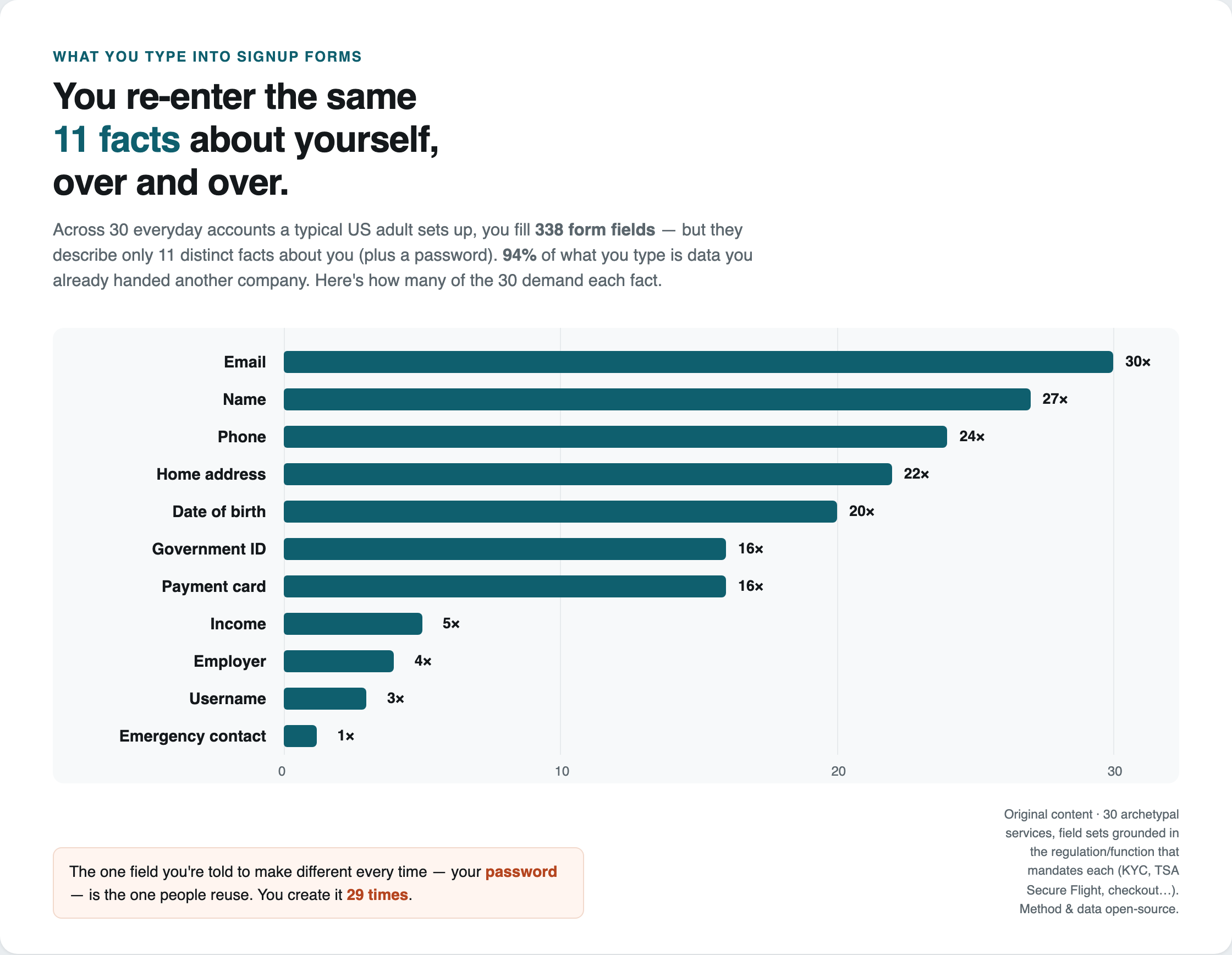
You type 338 things. They amount to 11 facts you already own — plus a password. Here's how many of the 30 services demand each one:
The irony
The field you're told to make unique is the one everyone reuses
Your password — the single field every security guide says to make different every time — is the one people reuse most. You create it 29 times across those 30 accounts. Everything else, the data that actually is you, you simply re-type, unchanged, over and over.
Every box, across 30 signups — the raw tedium, counted.
The average fact — your address, your DOB — re-entered sixteen times.
The one thing you're told never to repeat — created from scratch, again and again.
The method
A model, not a survey
We didn't poll users. We described 30 archetypal services a typical person actually uses, and for each one listed the fields it requires at signup — grounding every requirement in the law or function that mandates it, not a guess.
US adult, 2026, typical case — a model of 30 common services, not a survey of real users. Your own number will differ; the shape won't.
Two corrections during checking each lowered the count (340 → 338), and 94% held. Everything left out — payroll bank details, security questions, ID uploads — would only push it up. So 94% is a floor.
The real cost
The tedium isn't the cost. The copies are.
Every one of those 338 fields is another company holding another copy of the same 11 facts about you — another database to be breached, another privacy policy to change under you, another place you can't easily take it back from. You didn't decide to spread your identity across 30 companies. The forms decided for you.
That's the problem Simply Once is built to end: you assemble those facts once, in a vault only you can read, and fill any form from it — so the next signup is a tap, not a re-typing, and you always know who holds what.

Enter it once. Fill anything.
The 11 facts are yours. Simply Once keeps them encrypted, current, and ready — so you stop handing fresh copies to every form that asks.
Method and data are open — 30 modelled services, field sets grounded in the regulation or function behind each. Numbers current as of the 2026 model.